

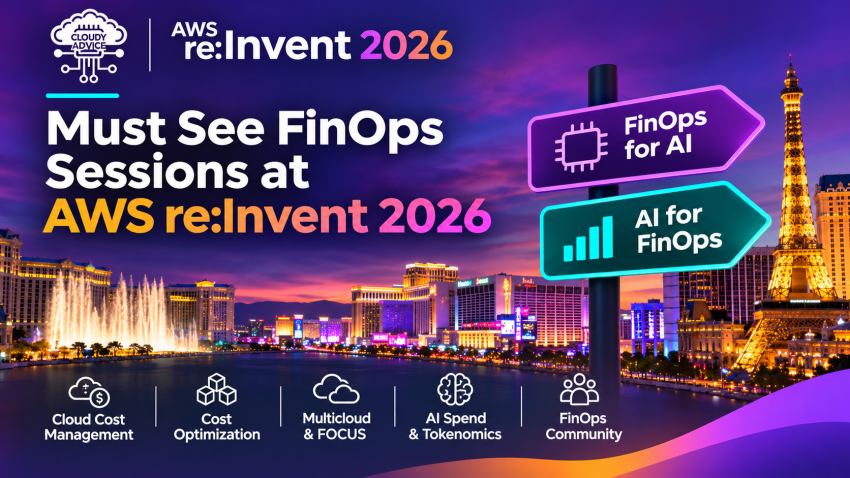
Introduction
It’s that time of year again… the annual pilgrimage to Las Vegas for AWS re:Invent!
A couple of years ago I wrote a blog post asking whether Generative AI had ruined the re:Invent experience. At the time, I was concerned about the number of traditional infrastructure and cloud management sessions being displaced by Generative AI content.
Interestingly, AI is now creating some of the most compelling challenges for those of us working in FinOps. Just as many organizations were getting reasonably good at managing their cloud spend, we’re being presented with an entirely new set of consumption models, pricing mechanisms, and cost allocation challenges.
How do you forecast AI spend? How do you allocate token consumption to individual applications and business units? How do you determine whether your investment in AI is actually delivering business value?
There’s also the flip side of this discussion: how can we leverage AI to make our existing FinOps practices more effective?
With re:Invent 2026 just around the corner, I’ve pulled together a list of sessions that I think are worth checking out for anyone involved in FinOps, cloud architecture, or cloud financial management.
FinOps Fundamentals
Despite all the excitement around AI, the fundamental challenges of managing cloud spend haven’t gone away. Many organizations are still struggling with basic cost allocation, forecasting, commitment management, and getting their engineering teams engaged in cost optimization.
COP209: Manage Cloud Costs and AI Spend with AWS Cost Management
Breakout Session — 200 Level
- Tuesday, December 1, 2:30–3:30 PM
- MGM Grand
This is probably the one breakout session that every FinOps practitioner should have on their agenda. It’s the annual opportunity to get caught up on the latest developments in the AWS Billing and Cost Management portfolio.
This year’s session also includes Corey Quinn and a customer perspective from AVIV Group.
I’m particularly interested in seeing how AWS continues to evolve its native cost management capabilities. The gap between what you can accomplish with native AWS tooling and what historically required a third-party FinOps platform has been narrowing. I expect that trend to continue.
COP312: Embed FinOps into Your CI/CD Pipelines
Builders’ Session — 300 Level
- Monday, November 30, 1:30–2:30 PM — Caesars Forum
- Thursday, December 3, 10:30–11:30 AM — Caesars Forum
Builders’ Sessions are perhaps my favorite session type, where you are working in small group with AWS product managers on deploying a working solution. If I had to pick one session to recommend to cloud infrastructure and DevOps engineers, it would probably be this one.
One of the challenges with traditional FinOps practices is that much of the work happens after resources have been deployed. We identify the spend, generate recommendations, and then try to convince an engineering team to go back and make changes.
Wouldn’t it be better to have that conversation before the infrastructure is deployed?
In this session, you’ll build cost estimation into a CI/CD workflow, allowing engineers to understand the financial implications of their infrastructure changes before they are implemented.
For those of us leveraging Infrastructure as Code with tools like Terraform, this is a particularly interesting area of development.
COP328: Building a Cost Governance Framework That Scales
Chalk Talk — 300 Level
- Wednesday, December 2, 4:30–5:30 PM — MGM Grand
- Thursday, December 3, 1:00–2:00 PM — MGM Grand
Building a FinOps practice that works across a large enterprise is a very different challenge from optimizing spend within a handful of AWS accounts.
How do you give engineering teams the autonomy they need while maintaining financial accountability? How do you establish governance without creating yet another centralized approval process that slows everyone down?
I’m a big fan of chalk talks at re:Invent because they provide an opportunity to hear how other organizations are approaching these problems. Often the most valuable part of the session is the discussion with other attendees. Adam Richter and Jason Wu are also great speakers so catch this session if you can!
COP329: Automate Savings with AWS Billing and Cost Management Services
Chalk Talk — 300 Level
- Wednesday, December 2, 4:30–5:30 PM — MGM Grand
- Thursday, December 3, 12:00–1:00 PM — Wynn/Encore
Generating cost optimization recommendations is relatively easy these days. Actually implementing those recommendations is another matter entirely!
This session looks at automating commitment management and resource optimization. If you are not already using a third-party tool to manage your committed use discount purchases, this is a great session for you.
I’d be particularly interested in the discussion around guardrails. Automating a Savings Plans purchase or rightsizing a production resource requires a very different level of confidence than simply generating a recommendation.
FinOps in a Multicloud World
HMC302: How Max Mara Built Multicloud FinOps with Open Source
Lightning Talk — 300 Level
- Monday, November 30, 2:00–2:20 PM
- Wynn/Encore
This session caught my attention for a couple of reasons: FOCUS and open source.
I’ve been a big proponent of the AWS Cloud Intelligence Dashboards for several years and have written about them previously on this blog.
One of the challenges for organizations operating across multiple public cloud providers is the amount of effort required to normalize billing data. Each provider has its own terminology, billing constructs, and data formats.
The FinOps Open Cost and Usage Specification (FOCUS) has the potential to significantly reduce that complexity.
This session looks at how Max Mara brought together cost data from multiple cloud providers and developed unit economics using open-source tooling.
I wish this were a full-length breakout rather than a 20-minute lightning talk!
FinOps for AI
Managing the cost of AI is shaping up to be one of the next big challenges for FinOps practitioners.
Traditional infrastructure cost optimization is relatively straightforward by comparison. We understand what a vCPU is, what a GB of storage costs, and how to evaluate the utilization of a compute instance.
AI introduces a whole new set of variables. Model selection, input and output tokens, context windows, caching, inference, and increasingly complex agentic workflows all have an impact on the cost of delivering an application.
Here are a few sessions that look particularly interesting.
COP311: FinOps for AI: Cost Allocation Strategies for Amazon Bedrock
Builders’ Session — 300 Level
- Wednesday, December 2, 4:30–5:30 PM — Wynn/Encore
- Thursday, December 3, 10:30–11:30 AM — Wynn/Encore
This is high on my list. My good friend Yuriy Prykhodko, chief maintainer of the Cloud Intelligence Dashboards, is one of the presenters here
As organizations build shared AI platforms, one of the first challenges they’re going to encounter is how to allocate the cost of that platform back to the teams and applications consuming it.
Having visibility into the total cost of Amazon Bedrock across an AWS account is useful, but it’s not nearly granular enough for many enterprise chargeback models.
This session covers attribution of individual API requests, analysis using CUR 2.0, and visualizing token costs using the CUDOS dashboard.
COP403: Optimize AI Apps on Amazon Bedrock for Cost, Latency, and Control
Code Talk — 400 Level
- Monday, November 30, 11:30 AM–12:30 PM — Wynn/Encore
- Wednesday, December 2, 8:30–9:30 AM — Wynn/Encore
One of the things I find interesting about AI cost optimization is how closely intertwined it is with application architecture.
Simply switching to a less expensive model may reduce your cost, but what impact does that have on the quality of the response? What about latency? Can you accomplish the same business outcome with fewer tokens?
Steph Gooch is a rockstar presenter from AWS who never disappoints, and this session should provide a good technical understanding of those trade-offs through live coding demonstrations.
ARC204: Architectural Patterns for Predictable Multi-Agent Costs at Scale
Chalk Talk — 200 Level
- Monday, November 30, 1:30–2:30 PM
- Wynn/Encore
Agentic AI introduces an interesting financial challenge. Unlike a relatively predictable application making a single API call, an AI agent can initiate a series of additional calls, invoke tools, and interact with other agents.
How do you design an architecture where those costs are predictable? I think this is a topic that FinOps practitioners and enterprise architects should be spending more time discussing together.
IND3306: How Ramp Tracks and Governs AI Spend Down to the Team, Model, and API Key
Breakout Session — 300 Level
- Wednesday, December 2, 1:30–2:30 PM
- Wynn/Encore
I tend to prioritize sessions where customers share their experiences implementing a solution. I want to hear about the problems they encountered, the things that didn’t work, and what they would do differently.
As more organizations centralize access to AI models, the approach Ramp has taken to cost attribution and governance should be relevant to a lot of enterprises.
IND307: Mastering LLM Tokenomics: From Token Costs to Business Outcomes
Chalk Talk — 300 Level
- Monday, November 30, 3:00–4:00 PM
- Wynn/Encore
I suspect we’re all going to be hearing the word tokenomics quite a bit at re:Invent this year.
While understanding the cost per million tokens is important, it doesn’t necessarily tell you much about the value being delivered to the business.
I’d much rather understand the cost per customer support issue resolved, the cost per document processed, or the cost per successful business transaction.
This is where I see a real opportunity to apply the unit economics concepts that have been part of the FinOps Framework for years.
AI for FinOps
While much of the discussion around FinOps and AI is focused on controlling AI spend, I’m equally interested in how we can use AI to improve the way we manage our existing cloud spend.
COP324: AI-Powered FinOps: Cloud Cost Optimization in Practice
Workshop — 300 Level
- Monday, November 30, 8:30–10:30 AM — Wynn/Encore
- Wednesday, December 2, 3:30–5:30 PM — MGM Grand
This two-hour workshop covers a wide range of practical optimization and reporting scenarios, including containers, AI workloads, multicloud environments, and AI-assisted cost analysis.
I’m interested in seeing how AI can help reduce some of the operational overhead associated with running a FinOps practice.
How much time do we spend each month investigating cost anomalies, building reports, answering questions about cloud bills, and identifying optimization opportunities?
If we can reduce the amount of time spent on those activities, we can spend more time working directly with engineering teams and the business.
Of course, there’s a certain irony in spending money on AI to figure out how to spend less money on AWS!
Don’t Forget About the FinOps Community
One of the primary reasons I keep coming back to re:Invent is the opportunity to spend time with other people working through many of the same challenges that I am.
As a FinOps Ambassador, I’d encourage anyone interested in FinOps to spend some time engaging with the broader community.
FinOps Foundation Community Event
- Tuesday, December 1
- Rockhouse at The Venetian
The FinOps Foundation, along with the FOCUS team and the Tokenomics Foundation, is hosting a keynote watch party and networking lunch.
These types of events are a great opportunity to meet other FinOps practitioners and have conversations that aren’t necessarily focused on a particular cloud provider or commercial product.
Register for the FinOps Foundation event here.
AWS Cloud Financial Management Kiosk
The AWS Cloud Financial Management kiosk is returning to the Expo this year.
This is a great opportunity to speak directly with the people building the AWS cost management tools, get demonstrations of the AWS FinOps Agent, and provide feedback on features you’d like to see added to the platform.
The FinOps Foundation team is also scheduled to be at the kiosk on Tuesday from 4:30–6:00 PM.
If you’ve been frustrated by a particular limitation in the AWS billing tools, this is a good opportunity to have that conversation with the people who might actually be able to do something about it.
If You Can Only Attend Five Sessions…
There are far more interesting sessions than anyone can reasonably attend in a week, particularly given the amount of time you’ll spend traversing the Las Vegas Strip.
If I were putting together a short list, I’d prioritize the following:
| Session | Topic |
|---|---|
| COP209 | What’s new in AWS cost management |
| COP312 | Shifting FinOps left into CI/CD |
| COP311 | Granular AI cost allocation |
| COP324 | Putting AI to work for FinOps |
| HMC302 | Multicloud FinOps, FOCUS, and open source |
I’d also prioritize workshops, chalk talks, and builders’ sessions over breakout sessions when there are scheduling conflicts. All breakout sessions are recorded and available for viewing after the conference. The opportunity to interact with the presenters and other attendees in a smaller setting is much harder to replicate.
Also, pay particular attention to Wednesday afternoon. Several of the FinOps sessions are scheduled at exactly the same time. Fortunately, many have repeat sessions on Thursday.
For additional sessions, check out the following resources:
- AWS re:Invent 2026 Session Catalog
- AWS Cloud Financial Management re:Invent 2026 Guide
- AWS Builder Center — AI Economics Attendee Playbook
- FinOps Foundation
- FOCUS Specification
Session times and locations are subject to change, so double-check the session catalog before finalizing your agenda.
Final Thoughts
I think we’re at an interesting point in the evolution of FinOps.
The scope of FinOps is expanding beyond traditional public cloud infrastructure to encompass AI, SaaS, private cloud, and other areas of technology spend.
But regardless of how the technology evolves, many of the fundamental principles remain the same.
We need good visibility into our spend. We need to allocate that spend to the people making the decisions that drive it. We need to enable engineers to make informed decisions about cost. And most importantly, we need to understand the business value we’re getting in return for our technology investments.
FinOps has never been just about saving money.
I’m looking forward to seeing how the AWS Cloud Financial Management portfolio evolves this year and, more importantly, hearing how other organizations are tackling these new challenges.
See you in Vegas!